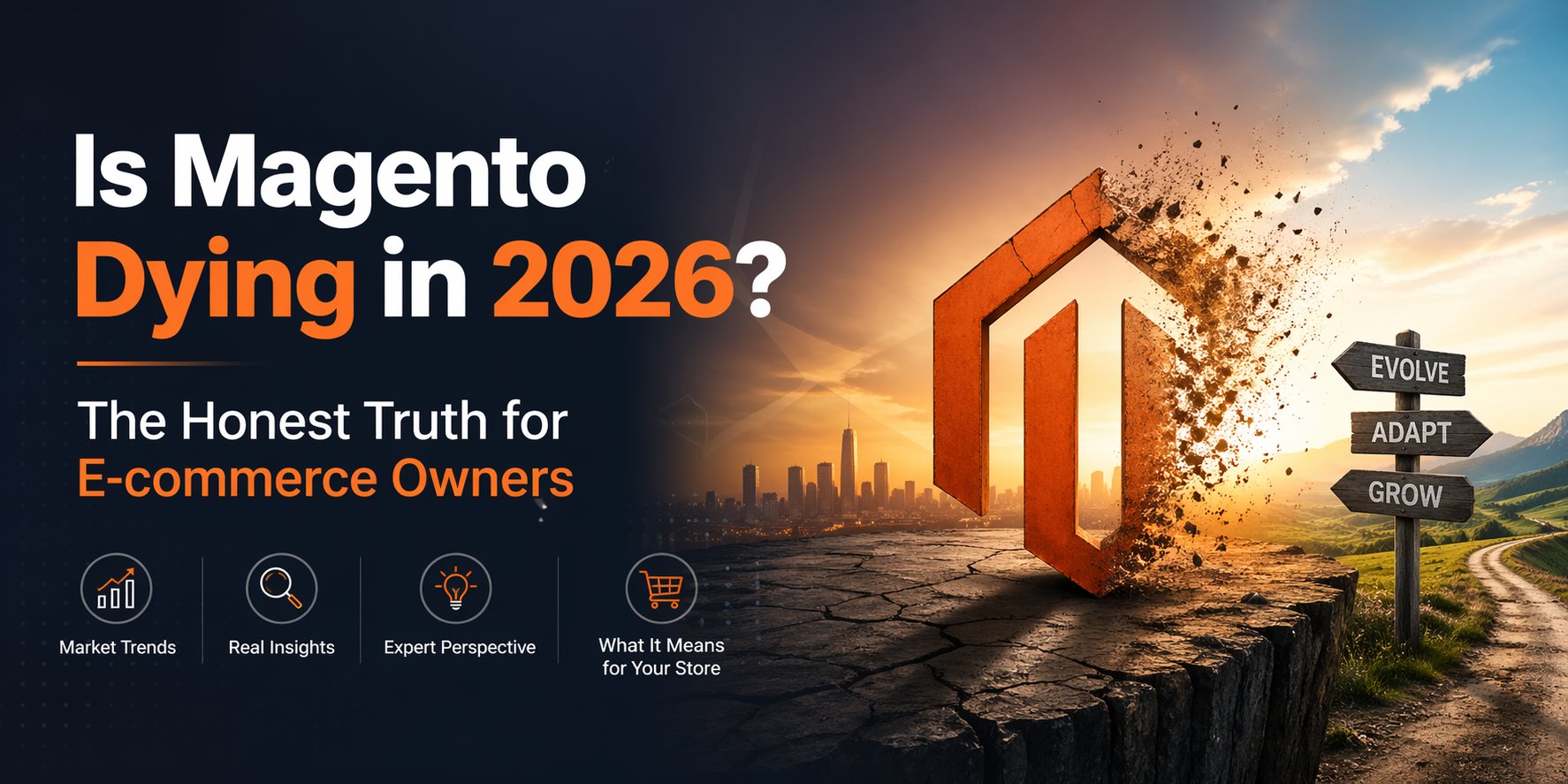

Is Magento Dying? The Real Truth About Its Future in 2026
If you’ve been in the e-commerce world for more than five minutes, you’ve probably heard the whispers. “Magento is too slow.” “Magento is too expensive.” “Everyone is moving to Shopify.”
It’s a valid concern. When you are investing thousands of dollars into a platform, you want to know if you’re building on a solid foundation or a sinking ship. So, let’s address the elephant in the room: Is Magento dying in 2026?
The short answer? No. But it is changing—drastically.
The Magento we knew in 2015 is gone. Today, the landscape is split between Adobe Commerce (the high-end enterprise version) and Magento Open Source (the community-driven version).
In this guide, I’ll take off the “salesperson” hat and give you the expert’s view on where the platform stands today, who should use it, and why the “dying” narrative is mostly a misunderstanding of market shifts.
1. The Numbers: Is Magento Losing Market Share?
Let’s look at the facts. According to 2026 industry data, the total number of Magento stores has declined by about 10% year-over-year. Meanwhile, platforms like Shopify and WooCommerce are seeing millions of new users.
Does this mean Magento is failing? Not exactly. It means the wrong people are finally leaving.
The Great Migration of Small Businesses
Five years ago, small “mom-and-pop” shops often chose Magento because it was the “big name.” They quickly realized they didn’t need a Ferrari to go to the grocery store. Maintaining a Magento site requires:
- High-performance hosting.
- Regular security patches.
- Expensive developer hours.
Small merchants are migrating to SaaS (Software as a Service) platforms like Shopify because it’s easier. This “loss” of market share is actually a healthy correction. Magento is reclaiming its identity as a heavy-duty tool for heavy-duty businesses.
The Enterprise Stronghold
While store counts are down, the Total GMV (Gross Merchandise Volume) passing through Magento is higher than ever. Big brands aren’t leaving. In fact, roughly 20% of the top 1,000 retailers in the US still rely on Magento/Adobe Commerce.
2. Why People Think Magento is Dying
To understand the future, we have to look at the pain points that fuel the “dying” rumors.
Complexity and “The Developer Gap”
Magento is famous for its steep learning curve. Finding a “cheap” Magento developer is easy; finding a good one is like finding a needle in a haystack. Because the architecture is complex, bad code can break a site easily, leading to the “Magento is buggy” reputation.
The Cost of Ownership
Running a Magento store isn’t just about the license (which is free for Open Source). It’s about:
- Hosting: You can’t run this on a $5/month shared server.
- Maintenance: Security updates and version upgrades (like the move to PHP 8.3+) require technical expertise.
SaaS Competition
Shopify and BigCommerce have spent billions making e-commerce “plug-and-play.” For a business that just wants to sell a few T-shirts, Magento feels like overkill.
3. The 2026 Rebirth: Why Magento is Actually Winning
If Magento were truly dying, Adobe wouldn’t be pouring money into it. Here is why the platform is actually more powerful in 2026 than it has ever been.
Adobe Commerce & AI Integration
Adobe has integrated “Adobe Sensei” (their AI engine) directly into the platform. This provides:
- Live Search: AI-powered results that learn what your customers want.
- Product Recommendations: High-level upsells that used to cost thousands in custom coding.
The Rise of Hyvä Themes
For years, Magento’s biggest weakness was a slow, clunky frontend (Luma). In 2026, the Hyvä Theme has completely changed the game. It allows developers to build lightning-fast, SEO-friendly storefronts with a fraction of the code. This has single-handedly saved Magento for many mid-market merchants.
B2B Dominance
This is where Magento kills the competition. If you are a B2B company that needs:
- Custom pricing for different customer groups.
- Requisition lists and “Quick Order” forms.
- Multi-warehouse inventory management.
No other platform—not even Shopify Plus—reaches the native depth of Magento’s B2B suite.
4. Expert Tips: Is Magento Right for YOU?
Before you decide to stay or switch, ask yourself these three questions:
- Is your catalog complex? If you have 50,000 SKUs with complex configurations, Magento is your best friend.
- Do you need “Ownership”? If you don’t want a platform to be able to shut down your store or change their “Terms of Service” on a whim, you need a self-hosted platform like Magento.
- Do you have the budget? If you can’t afford at least $1,000–$2,000 a month for maintenance and hosting, you should probably look at Shopify.
Mistakes to Avoid
- Don’t DIY it: Magento is not a “weekend project.” Trying to set it up without a certified developer will lead to security holes.
- Don’t ignore updates: Running an old version of Magento (like 2.3 or 2.4.0) is the #1 way to get hacked.
- Don’t over-extend with extensions: Every extension you add slows down the site. Use only what you need.
5. Actionable Steps for Magento Store Owners in 2026
If you are currently on Magento and feeling the “dying” vibes, do these three things to future-proof your business:
- Audit Your Tech Stack: Are you using 50+ plugins? See what can be replaced with native features or custom code.
- Switch to Hyvä: If your site feels slow, don’t leave Magento. Just change the “skin.” Hyvä will give you 90+ Google PageSpeed scores instantly.
- Explore Headless Commerce: Use Magento as your “brain” (backend) and a modern framework like React or Vue as your “face” (frontend). This is the gold standard for 2026.
FAQ Section
Q1: Is Magento Open Source still free?
Yes. Magento Open Source remains free to download and use. However, you are responsible for hosting, security, and development costs.
Q2: Is Shopify better than Magento?
“Better” is subjective. Shopify is better for speed-to-market and ease of use. Magento is better for customization, complex B2B workflows, and total data ownership.
Q3: How much does a Magento website cost in 2026?
A professional Magento build typically starts at $20,000 and can go up to $250,000+ for enterprise-level sites with ERP integrations.
Q4: Is Magento still good for SEO?
Yes, it is one of the most SEO-flexible platforms available. Out of the box, it offers clean URLs, sitemaps, and canonical tags. With a fast frontend like Hyvä, it’s an SEO powerhouse.